If you have been researching new advertising options for 2026, you may have come across FeedBuzzard. The name appears in marketing discussions and online guides, but there is still some confusion about what the platform offers and how businesses can actually use it.
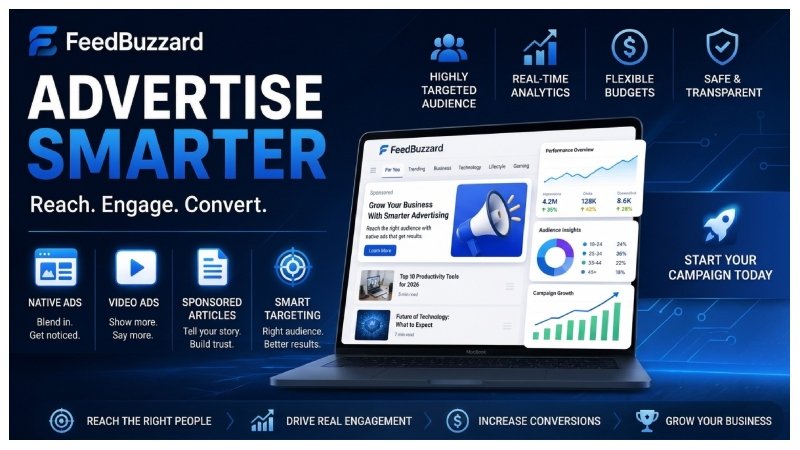
FeedBuzzard is presented as a digital advertising and content platform where marketers can promote products, services, and websites through different types of placements. Its current advertising information mentions native cards, banner ads, video spots, and sponsored articles, along with audience targeting and campaign tracking.
That makes FeedBuzzard worth a closer look for businesses that want another way to reach online audiences without depending entirely on the biggest advertising networks.
What Is FeedBuzzard Advertising?
FeedBuzzard advertising is designed around placing promotional content where users are already consuming digital content. Instead of relying only on traditional banner placements, advertisers can use formats that fit naturally into feeds, articles, and other digital environments.
According to FeedBuzzard’s current advertising guide, the platform supports several formats, including native cards, banners, videos, and sponsored articles. These options give businesses different ways to present their message depending on their campaign goal.
For example, a company trying to build awareness might prefer a visual banner or video, while a brand with a more detailed story to tell could benefit from sponsored content.
Why Native Advertising Gets Attention
Traditional display advertising has an obvious weakness: people can become accustomed to seeing banners and start ignoring them.
Native advertising takes a different approach. The promotional unit is designed to fit into the surrounding content, which can make it feel less disruptive. That does not automatically make every campaign successful, but relevance and good creative can make a significant difference.
The key is not simply to make an advertisement look like normal content. The message should still be clear about its promotional nature while giving users a genuine reason to pay attention.
FeedBuzzard Ad Formats
One of the useful things about FeedBuzzard is the variety of advertising formats currently described by the platform.
Native Ads
Native cards can fit naturally into content feeds and recommendation-style environments. They can be useful when the advertiser wants to encourage users to discover a product, article, service, or landing page.
Banner Advertising
Banner ads remain useful when the main objective is visibility. They can communicate a short message, promote a product, or direct users toward a specific website.
Video Advertising
Video can help businesses explain products or demonstrate services more effectively than a small static advertisement. FeedBuzzard’s current advertising information lists video as one of its supported formats.
Sponsored Articles
Sponsored articles provide more space to explain an idea. Instead of asking users to understand a product from a short advertisement, a sponsored article can provide context, benefits, examples, and a clear next step.
For businesses selling complicated software or digital services, this format can be particularly useful because the audience has more information before reaching the final offer.
FeedBuzzard Targeting Options
Audience targeting is one of the most important parts of any digital advertising campaign.
FeedBuzzard’s current guide describes targeting based on demographics, interests, lookalike audiences, keywords, devices, operating systems, and geographic locations. It also mentions custom audience options using customer lists.
This means advertisers can potentially start with a broader audience and then narrow their campaigns after identifying which groups perform best.
For example, a technology company might begin by targeting a wider technology-focused audience. After collecting enough performance data, it could concentrate more of its budget on the locations, devices, or audience segments generating better results.
How FeedBuzzard Budgeting Works
Budget control matters because testing a new advertising platform should not require committing a large amount of money immediately.
FeedBuzzard’s published information says advertisers can set daily budgets and campaign caps. It also describes CPM, CPI, and CPC pricing models.
The right model depends on what you are trying to achieve.
If the goal is visibility, a CPM-based campaign may make sense. If the goal is traffic, CPC can provide a more direct way to evaluate clicks. For campaigns focused on app installs or similar actions, CPI may be more relevant.
The important thing is to decide on the goal before choosing the pricing model.
How to Start a FeedBuzzard Campaign
The campaign process can be approached in a fairly simple sequence.
First, define one primary objective. Do you want traffic, awareness, leads, sales, or another measurable result?
Next, choose the audience and geographic areas you want to reach. After that, select an appropriate ad format and prepare your creative assets.
FeedBuzzard’s current guide also recommends adding conversion tracking, reviewing the advertisement before launch, and monitoring performance during the first 48 to 72 hours.
This early monitoring period is important because it gives advertisers an opportunity to identify weak creatives or poorly matched audiences before spending too much of the budget.
How to Measure FeedBuzzard Advertising Results
Getting clicks is not the same thing as getting customers.
A campaign can produce a good click-through rate while generating very few sales or leads. That is why advertisers should look beyond impressions and clicks.
Useful metrics can include:
- Impressions
- Click-through rate
- Cost per click
- Conversion rate
- Cost per acquisition
- Leads generated
- Revenue from the campaign
Looking at several metrics together provides a much clearer picture of campaign performance.
For example, an advertisement may receive fewer clicks than another creative but generate significantly more sales. In that situation, the campaign with the lower click volume could actually be the better investment.
FeedBuzzard for Small Businesses
Small businesses do not necessarily need huge advertising budgets to test a new platform.
A controlled experiment can be a better starting point. Choose one audience, one campaign objective, and a limited daily budget. Run the campaign long enough to gather meaningful data, then compare the results with your existing marketing channels.
This approach reduces the risk of spending heavily before knowing whether the audience is a good match for your offer.
FeedBuzzard for Technology and Online Brands
Digital businesses may find this type of advertising particularly interesting because their customers are already comfortable discovering products and services online.
Software companies, apps, online stores, gaming brands, digital services, and technology businesses can test different creative formats and audiences to see which combination produces the strongest response.
However, the platform itself cannot fix a weak product or poor landing page. If visitors arrive at a confusing website, advertising spend can be wasted regardless of how good the targeting is.
Common Mistakes to Avoid
One of the biggest mistakes advertisers make is trying to target everyone.
A broad audience may look attractive because it offers more potential impressions, but relevance usually matters more than raw exposure.
Another common mistake is launching a campaign without conversion tracking. Without tracking, it becomes difficult to know whether advertising is producing meaningful business results.
Using only one creative can also limit learning. Testing different headlines, images, formats, or calls to action can reveal which message connects better with the audience.
Finally, advertisers should avoid judging a campaign too quickly. Initial results can fluctuate, so decisions should be based on enough data rather than a handful of clicks.
Is FeedBuzzard Worth Trying in 2026?
Whether FeedBuzzard is worth trying depends on the business, audience, budget, and campaign objective.
The platform’s current advertising information shows a broader set of options than a simple banner-only website. Native cards, banners, videos, sponsored articles, audience targeting, budget controls, and conversion tracking give advertisers several ways to test campaigns.
That does not mean every business will get the same results. A sensible approach is to start with a controlled campaign, track the numbers carefully, and compare the results against other channels.
Final Thoughts
FeedBuzzard is an advertising option that businesses can investigate as part of a wider digital marketing strategy in 2026. Its current information describes multiple ad formats, audience targeting features, budget controls, and performance tracking tools.
The biggest advantage for an advertiser is flexibility. Instead of relying on one type of advertisement, businesses can experiment with native content, banners, video, and sponsored articles to discover what works for their audience.
The smartest approach is to treat FeedBuzzard as a test rather than a guaranteed source of traffic or sales. Set a clear objective, start with a manageable budget, track conversions, and use the resulting data to decide whether the platform deserves a larger share of your marketing budget.